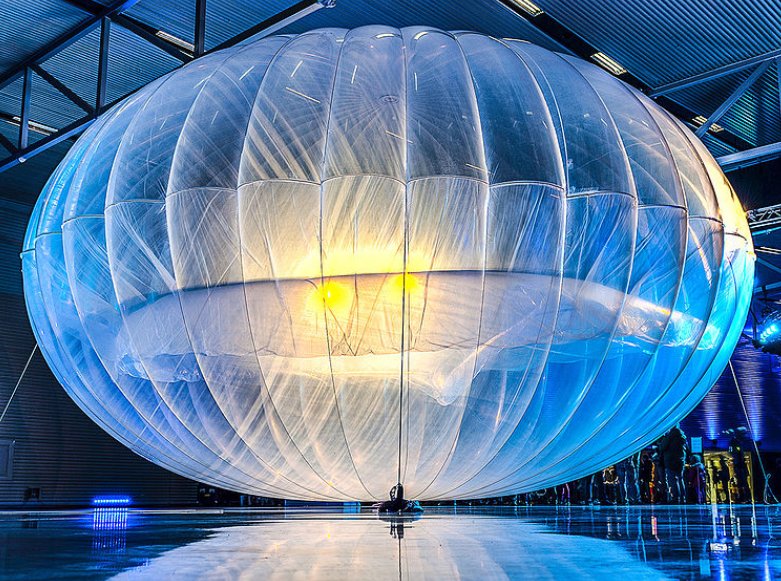
Google’s Project Loon is an effort to bring internet connectivity to areas all around the world that don’t currently have access to it. They aim to accomplish this task with a fleet of balloons that are launched into the stratosphere and give LTE connectivity to a perimeter of ground area. Project Loon has been a big focus this last week as we’ve received news from Google I/O, the company’s developer conference held in San Francisco, that Google has two major updates regarding its Project Loon program. We may be keeping an eye to the sky as it seems that there will most likely be a lot more Google balloons flying about before we know it.
Currently, Google has been testing their balloons in California’s Central Valley. From Google:
“The purpose of these flights is to allow us to research various approaches for improving the technology, like the power systems (solar panel orientation and batteries), envelope design, and radio configuration.”
The first big update that Google has announced is something called the Bird House or, to the public, the Autolauncher. Google Vice President Mike Cassidy described the previous process that it took to get the Project Loon balloons up in the air as taking about 45 minutes per balloon. These balloons could also only be launched when the wind was 6 MPH or less. With the Autolauncher, however, a balloon can be launched in only 15 minutes when the wind is up to 15 MPH or less. This is accomplished using huge canvas sides to help block the wind while a four person team launches the balloon.
The second update Google has announced is that they have figured out a way to allow the balloons to communicate with one another as part of a giant mesh network. Prior to this, balloons had to be within about 80 kilometers of a ground station in order to have internet connectivity. They have now updated their project to free the balloons from their need to be within that range of a ground station.
With the balloons communicating with one another as part of a mesh network, an individual balloon can travel anywhere from 400 to 800 kilometers away from a ground station while maintaining connectivity. This drops the price of the project exponentially for Google, since they won’t have to have ground stations every 80 kilometers. This is a huge difference and a great addition to the project.
Things seem to be headed in a continually positive direction for Google’s Project Loon. I continue to believe that this project is going to be revolutionary one when considering the internet as we, and as people around the world, currently know it. There have been some skeptics though. Perhaps one of the most noted is Bill Gates who gave an interview with Bloomberg Businessweek expressing his skepticism.
When asked if bringing Internet access to parts of the world that don’t have it could help solve secondary problems, he answered:
“When you’re dying of malaria, I suppose you’ll look up and see that balloon, and I’m not sure how it’ll help you. When a kid gets diarrhea, no, there’s no website that relieves that. Certainly I’m a huge believer in the digital revolution. And connecting up primary-health-care centers, connecting up schools, those are good things. But no, those are not, for the really low-income countries, unless you directly say we’re going to do something about malaria.”
We want to know what you think. Comment below!